From social signaling to evolutionary advantages, a full head of hair is highly prized by humans not only for self-image but for biological protection. Did you know the hair on your head provides UV protection for your scalp, regulates your head’s temperature and acts as a sensory buffer?
It also provides sensory input. Your hair follicles are connected to nerves, acting as a sensory system for, among other things, detecting movement on your skin or in close proximity to you. Hair follicles can sense imminent physical contact, breezes and other movements of air, sending signals to the brain to heighten awareness of your immediate environment and imminent danger.
Emotionally and psychologically, hair is strongly tied to self-Image, social and sexual attraction, youth, health and confidence. That is part of why hair loss often triggers shame or a loss of self-confidence.
Even with all the hair restoration options available today, most people do not seek treatment for thinning hair or hair loss. People are more likely to hide it – with wigs, toupees, hair extensions or hats – than restore healthy, natural hair growth.
Oftentimes, resignation sets in and – particularly for older individuals – hair loss is simply accepted as a natural part of aging. You do not have to accept it. Schedule a consultation to restore your full, healthy, natural head of hair. Call New Life Aesthetics in Raleigh, NC, at (919) 521-8282 or contact us online today!
When it comes to hair loss, does gender matter? Compared to women, statistics have historically shown that men are almost twice as likely (1.7x) to experience hair loss. But those statistics may be shifting. A recent 2025 study found that women in four generations – Baby Boomers, Gen X, Millennials and Gen Z – are reporting higher rates of hair thinning and loss as compared to men. These new studies are upsetting the conventional wisdom that men are more likely to experience hair loss.
Still, the most widely reported statistics and the general consensus suggest:
At least 50 percent of women experience noticeable hair thinning or hair loss in their lifetimes. Approximately 40 percent of women show signs of female pattern hair loss by age 50. With the onset of menopause, as many as two-thirds of women experience hair loss. While it is increasingly beginning earlier, hair loss is most common after age 40.
One in four will experience hair loss by age 25. A tremendous number experience some form of hair loss. Estimates suggest over 85 percent of men will see significant thinning or baldness in their lifetime. Male hair loss is almost always due to male pattern baldness (androgenetic alopecia). This specific condition affects roughly two-thirds of men by age 35, 85 percent by age 50, and up to 90 percent by age 90. Driven by genetics and DHT levels, male pattern baldness accounts for roughly 95 percent of hair loss in men.
Teasing out what is causing your hair thinning or hair loss is not always a simple undertaking, but there are some notable risk factors and causes that top the list.
Though women are less likely than men to go completely bald, men and women both can suffer with pattern baldness. Sufferers have a genetic sensitivity to dihydrotestosterone (DHT) which shrinks and shortens the lifespan of hair follicles, eventually causing them to stop producing hair. Male-pattern baldness is a receding hairline pattern with hair thinning from the crown upward. Female-pattern baldness begins from a woman’s part line, which slowly widens as the hair around it thins out, until a “see-through” area develops at the top of her scalp. Hair at the temples may also gradually recede.
These are your sex drive and hair growth regulators. When out of balance, they can trigger hair loss.
From Vitamin D and iron to zinc, biotin and Vitamin B-12, certain vitamin deficiencies can contribute to or even cause hair loss. Deficiencies can develop from poor diet, malabsorption, or increased nutritional needs as seen in pregnancy.
Stress really does cause hair loss. It can Interrupt your hair’s growth cycle, pushing follicles from the active growth phase into the resting phase. By forcing hair follicles into a premature resting phase (telogen effluvium), it can lead to shedding months after a stressful event. Also, high cortisol – commonly known as the stress hormone – can inhibit growth-promoting molecules, causing hair follicles to remain dormant rather than regenerating new hair.
Hair loss during pregnancy is generally uncommon since high estrogen levels protect hair. Some women may experience mild thinning or shedding due to nutritional deficiencies, thyroid issues or stress. However, significant postpartum hair loss is very common two to four months after birth.
Other key factors include:
Each hair follicle’s bulb contains stem cells that divide every 23 to 72 hours, faster than any other cells in your body – until age and genetics slow them down. As follicles shrink, hair grows thinner, finer, and more prone to breakage. Although eventually follicles stop growing hair, they remain alive and open to re-stimulation.
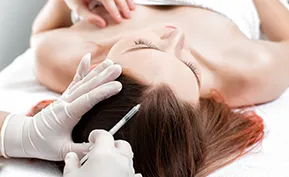
PRF hair restoration therapy involves a simple procedure that draws approximately two teaspoons of blood from your arm and then spins it in a centrifuge to isolate powerful platelets containing growth factor proteins and exosomes, which are then injected into your scalp.
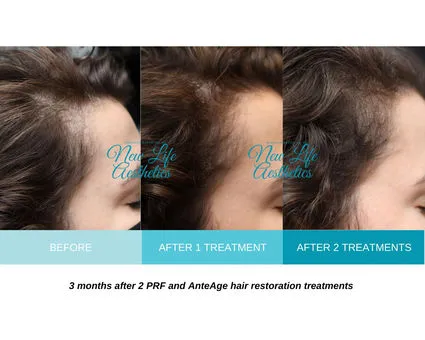
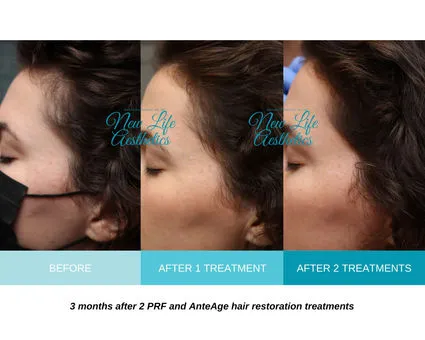
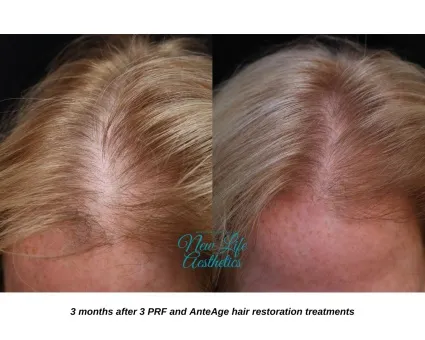
PRF hair restoration injections signal your hair follicle stem cells to begin dividing again, so they can create fresh collagen and blood vessels. Each custom dose of PRF serum targets each follicle’s hair-growing capacity – and may even grow new ones – thereby enhancing the health and thickness of your hair.
Platelet-Derived Growth Factor (PDGF) for hair restoration is a non-surgical, regenerative treatment method that utilizes highly concentrated growth factors to awaken, stimulate and strengthen dormant hair follicles. Unlike PRP or PRF, which rely on your own blood's concentration of growth factors, pharmaceutical-grade PDGF offers a consistent, high-potency dose, which can often yield better results, including:
It offers a potent enhancer or alternative to treatments like PRP or PRF, and it is particularly effective at rejuvenating follicles to prevent further miniaturization.
Pharmaceutical-grade PDGF may be used as part of a customized hair restoration plan. Depending on the treatment, PDGF may be applied topically with SkinPen microneedling or used according to provider recommendation.
Nutrafol is a physician-formulated, plant-based supplement brand that targets thinning hair and promotes hair growth from within by addressing root causes like stress, hormones, inflammation and more. In fact, clinical studies show that over 90 percent of women saw overall improvement in their hair after six months, but you can see new hair growth in as little as three months.
Here at New Life Aesthetics, we have multiple formulas to address your hair health. Nutrafol offers formulas designed for mature women to improve hair growth by targeting key root causes of thinning – such as hormones and aging – during menopause, as well as several other hair loss solutions.
Nutrafol is just as effective for men as it is for women. Nutrafol takes a whole-body approach and targets the key root causes of hair thinning in both men and women, and it is often recommended by dermatologists as a drug-free solution for hair loss.
You can make it a combo too: try combining Nutrafol with our other hair growth treatments like PRF and PGDF.
Address your hair restoration goals today with PRF, PDGF, Nutrafol Hair Supplements or our New Life Aesthetics line of products for hair health and rejuvenation. Call (919) 521-8282 or contact us online to schedule your consultation today!
Nestled inside the beautiful Magnolia Place in the Crabtree District of Raleigh, New Life Aesthetics offers a full complement of aesthetic treatments and services in a private, serene and inviting location. New Life Aesthetics is owned and operated by Meredith Harris, NP. Her concept and dream of New Life became a reality in December 2014. Heather Shelton Roberts, RN, BSN, joined the practice in 2021. Meredith and Heather, your team of aesthetic nurses – together with a dedicated support staff – work together with a simple philosophy about aesthetics: We seek to provide the premier experience for each and every guest, from the very first touchpoint.